


6-minute read

Cynthia B. Kaye
Early Education Advocate | EdTech Innovator | CEO, Alive Studios
I’ve been thinking a lot about screen time lately, especially after recording a session for teachers working with our youngest learners — PreK through 2nd grade.
The more I read, the more I believe we are at an important turning point in early education.
Across the country, parents, educators, district leaders, and policymakers are asking hard questions about how much screen time is too much for young children. And honestly, they should be.
In April 2026, Los Angeles Unified School District approved a resolution to limit student screen time across the district. The resolution calls for a districtwide screen-time policy, a review of classroom technology contracts, limits on student-led use of YouTube and other streaming platforms, and developmentally appropriate guidance for different grade levels.
That matters.
When one of the largest school systems in the country says it is time to rethink screen use, education leaders everywhere should pay attention.
But this conversation should not be about being “for technology” or “against technology.”
It should be about being for children.
The Real Question Is Not Screen Time. It Is Screen Quality.
For years, we have talked about screen time as if all screen experiences are the same.
They are not.
A child passively watching short videos is not having the same experience as a child using a teacher-guided literacy activity.
A child clicking through random content is not having the same experience as a child creating a story, hearing letter sounds, practicing phonemic awareness, or using assistive technology to access learning.
A screen can be a tool. But it can also become a substitute for play, conversation, movement, handwriting, books, imagination, and human connection.
That is where we have to be honest.
Common Sense Media’s 2025 census found that children ages 8 and under spend about 2.5 hours a day with screen media. It also found that 40% of children have their own tablet by age 2, and children’s media habits are shifting toward more digital use, including gaming, short-form video, and emerging AI tools.
That should make all of us pause.
Not panic.
Pause.
Because early childhood is not just preparation for school. It is the foundation for language, attention, emotional regulation, motor development, problem-solving, creativity, and relationships.
Those things cannot be downloaded.
They are developed through interaction.
This Is Not Just My Opinion
The framework I use for thinking about screen time is not based on personal preference. It is grounded in guidance from respected early childhood and pediatric experts.
The American Academy of Pediatrics has moved away from a one-size-fits-all screen-time number for every child and instead emphasizes a more thoughtful approach to media use, including content, context, co-viewing, communication, and whether media is crowding out sleep, physical activity, family connection, and learning.
The NAEYC/Fred Rogers Center joint position statement also gives us an important foundation. It says technology and interactive media can support effective learning and development when used intentionally by early childhood educators, within developmentally appropriate practice, and in support of learning goals for individual children.
That is the balance.
Not all screen time is harmful.
Not all screen time is helpful.
The difference is in the purpose, the design, the adult guidance, and what the screen is replacing.
A Framework for Good Screen Time vs. Bad Screen Time
When we talk about screen time for young children, the better question is not only how much. The better question is: what kind?
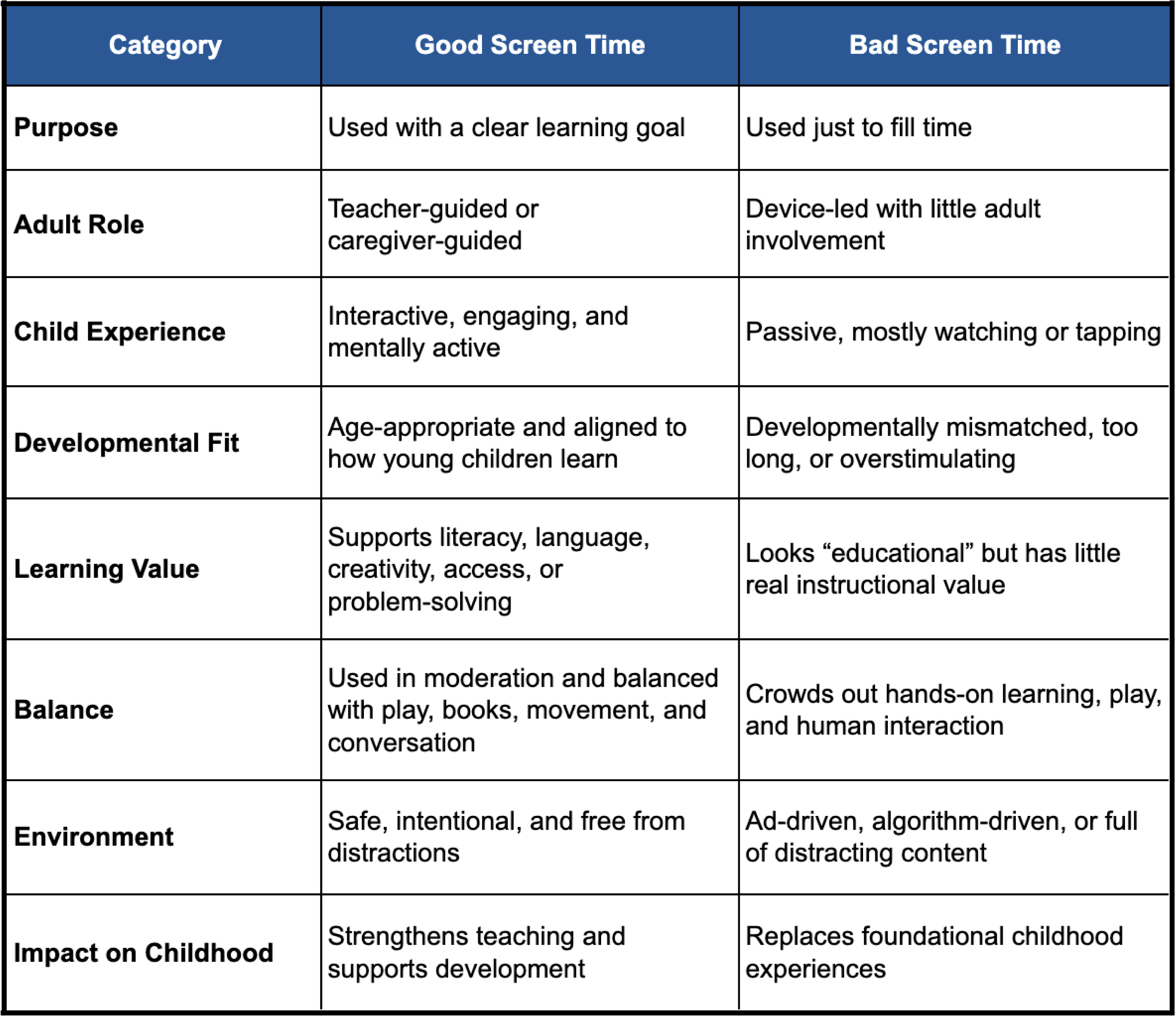
This is the conversation we need to have.
Not just, “Should children be using screens?” But:
• What is the screen asking the child to do?
• Is the child consuming or creating?
• Is the child isolated or interacting?
• Is the teacher guiding the experience, or has the device taken over?
• And most importantly: what is this screen replacing?
Why This Matters Even More in the AI Era
Now we have another layer entering the conversation: artificial intelligence.
AI is already showing up in classrooms, educational apps, literacy tools, assessment platforms, family communication systems, and teacher planning tools.
So the question is not whether AI will touch early education. It already has.
The question is whether we will use it wisely.
And the same questions we ask about screen time and technology should apply here as well:
• Is this improving the learning experience for the child?
• Or is it simply adding more screen time without meaningful value?
For PreK through 2nd grade, I believe AI should support the adults around the child. It can help teachers plan lessons, differentiate instruction, organize observations, support family communication, and find new ways to meet individual student needs.
What Education Leaders Should Be Asking
For principals, district leaders, policymakers, and workforce leaders, this moment calls for thoughtful decision-making.
Before approving a new digital tool for young children, we should ask:
• Does this strengthen the teacher-child relationship?
• Does this support early literacy, language, creativity, or access?
• Does this protect student privacy?
• Does this reduce teacher workload in a meaningful way?
• Does this require more screen time for children, or does it help adults teach better?
• Does this replace a hands-on learning experience children still need?
• Does this tool build human capacity, or does it outsource human responsibility?
Those are the questions that matter.
The Future Workforce Still Begins With Childhood
I often think about this from the perspective of my grandchildren and the world they will grow up in.
Like it or not, they are growing up in an AI-driven economy. We want them, and all children, to be digitally literate. We want them to be future-ready.
But future-ready does not mean screen-saturated.
The future workforce will need people who can think critically, communicate clearly, collaborate, regulate emotions, solve problems, adapt, create, and lead.
Those skills begin in early childhood.
They begin when a child listens to a story, explains their thinking, builds something and tries again, learns to share, asks questions, imagines, and persists.
Technology can support that.
But it cannot replace it.
We Need Balance, Not Extremes
I understand the screen-time backlash. In many ways, it is a necessary correction.
But we have to be careful not to throw out meaningful digital learning with harmful screen habits.
• There is a difference between a child being parked in front of random videos and a teacher using a short, intentional digital tool to support phonics.
• There is a difference between passive consumption and active learning.
• There is a difference between technology that distracts and technology that gives access.
• There is a difference between replacing childhood and strengthening instruction.
That is the conversation we need to have now.
Not more technology for the sake of technology.
Not no technology out of fear.
But the right technology, at the right time, for the right reason, guided by the right adults.
Because good technology should strengthen childhood.
It should not replace it.
And when we get that balance right, we are not just protecting young children today.
This isn’t just an investment in a child’s education, it’s an investment in the future strength of our workforce and the very communities these children will one day lead.
I’d love to hear your thoughts on this article!